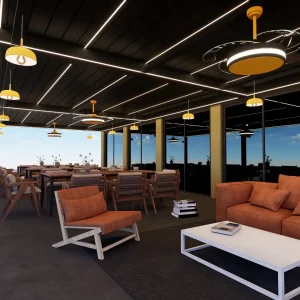
Vietnam Hospitality & Commercial Systems
Engineered Outdoor Living & Motorized Louver Modules
Primary high-performance modular systems deployed across Vietnamese luxury coastal resorts, rooftop developments, and premium F&B venues.
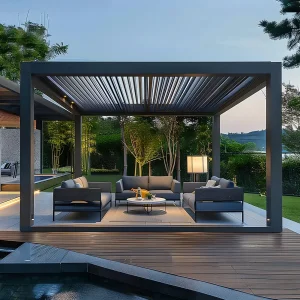
Urban Vietnam: Custom Electric Flip Pergola for Balcony & Deck Extensions
Explore System Specs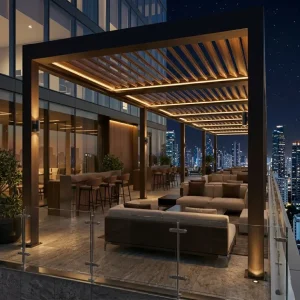
Wholesale Commercial Louvered Pergola for Vietnam B2B Supply Channels
Explore System Specs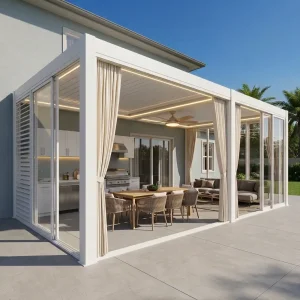
Monsoon-Rated: All-Weather Motorized Louvered Pergola for Vietnam Patios
Explore System Specs
Market Diagnostics & Regional Realities
The Vietnam Built Environment: Macroclimatic Pressures & Commercial Real Estate Demands
Understanding why standard roller blinds catastrophically fail in Vietnam and how precision-manufactured windproof zip track systems solve high-humidity, typhoon-force architectural challenges.
Vietnam represents one of Southeast Asia's fastest-growing construction, industrial manufacturing, and hospitality economies. However, its geographic profile—stretching across more than 3,200 kilometers of coastline along the South China Sea—imposes severe physical stresses on building facades and outdoor structures. From the tropical monsoon climate of the South (Ho Chi Minh City, Can Tho) characterized by relentless torrential downpours and intense Solar Heat Gain (SHGC), to the seasonal temperature variances and heavy typhoon corridors of Central and Northern Vietnam (Da Nang, Quang Ninh, Hai Phong), standard exterior shading fails within months due to track derailment, fabric tearing, and rapid salt-spray galvanic corrosion.
As commercial projects across Vietnam aggressively pursue international green building standards such as LOTUS (Vietnam Green Building Council), LEED v4.1, and EDGE (IFC World Bank), the demand for dynamic solar control has shifted dramatically. Architects and MEP consultants no longer specify static overhangs or standard drop screens. Instead, the architectural envelope requires motorized exterior windproof zipper blinds capable of dissipating up to 88% of solar radiation prior to contacting the glass glazing, while remaining structural during coastal squalls reaching Beaufort Scale 10 to 12.
130 km/h
Certified Wind Resistance (Beaufort 12)
88%
Total Solar Radiation Rejection (g-tot)
Qualicoat C5
High-Salinity Marine Anti-Corrosion
100%
Insect & Horizontal Rain Barrier
Engineering Excellence
Technical Anatomy of Typhoon-Resistant Zip Screen Architecture
A granular breakdown of the mechanical tolerances, internal tension dampers, and metallurgical coatings engineered specifically for harsh Southeast Asian industrial environments.
Dual-Core Extruded Zip-Locking Tracks
Utilizing high-tensile 6063-T6 architectural aluminum profiles with integrated co-extruded PVC inner guides. The continuous high-frequency welded zipper bead prevents fabric pullout even under sustained lateral wind loads exceeding 1,200 Pascals.
Kinetic Internal Tensioning Systems
Equipped with internal weighted bottom bars and integrated dual-spring dampers that maintain planar tension across wide spans up to 6.0 meters. Prevents fabric rattling, structural deflection, and motor fatigue during coastal convective thunderstorms.
C5-M Marine Fluorocarbon Finishes
Treated with AkzoNobel or PPG Qualicoat Class 2 certified architectural powder coatings (60-80 microns thickness). Guaranteed 15-year resistance against micro-cracking, gloss loss, and blistering in high-salinity atmospheres such as Nha Trang and Cam Ranh.
| Performance Dimension | Standard Drop Screen (Commodity) | Summer Heaven Industrial Zip System (Vietnam Spec) | Engineering Compliance Verification |
|---|---|---|---|
| Wind Pressure Rating | Class 1 (< 28 km/h / 40 Pa) - Derails easily | Class 6 / Beaufort 11-12 (> 120 km/h / 1200+ Pa) | EN 13561:2015 / TCVN 2737:2023 Wind Load Standards |
| Fabric Retention Mechanics | Free-hanging cable or side rod | Continuous Welded Keder Zip in PVC Cushion Rails | Zero-Gap Side Enclosure / Hermetic Lateral Seal |
| Solar Optical Control | High glare transmission, internal heat retention | 1% to 5% Openness Factor Fiberglass/PVC Core | g-tot < 0.12 (Blocks 88% solar infrared heat) |
| Corrosion Resistance (Salt Spray) | ASTM B117 < 250 Hours (Corrodes in coastal air) | ASTM B117 > 3,000 Hours (Marine C5-M Qualified) | AAMA 2604/2605 & Qualicoat Seaside Specifications |
| Automation Protocol | Basic unmonitored line-voltage switch | Obstacle-Sensing Smart Tubular Motors (RS485/Zigbee) | Seamless Modbus / KNX / Crestron BMS Integration |
B2B Procurement Framework
Global Enterprise & Project Procurement Dynamics
How tier-1 real estate developers, EPC contractors, and international facade consultants optimize supply chain velocity and mitigate installation risks in Southeast Asia.
OEM/ODM Customization for General Contractors
Global procurement teams executing multi-hectare mixed-use developments in Hanoi or HCMC require deep manufacturing agility. We provide complete OEM/ODM production lines: bespoke extrusion dies, custom-milled mounting brackets designed for structural steel or curtain-wall mullions, and private-label packaging configured down to specific project phases and floor levels.
Container Load Optimization & Direct Sea Freight
Freight efficiency directly influences B2B project margins. By shipping factory-direct from our advanced production facilities near major deep-water ports, we engineer custom nested packaging modules that eliminate dead air volume. A single 40ft High Cube container can comfortably accommodate up to 450 complete motorized zip blind units or consolidate mixed shipments containing pergolas, louvered roofs, and side enclosures with zero freight damage.
Pre-Assembly QA/QC & Defect Mitigation
Every zip screen manufactured for the Vietnamese market undergoes a mandatory 100% dynamic test-hang protocol on automated computerized testing racks prior to boxing. Motor amperage draw, travel end-stops, fabric planar squareness, and zipper engagement tolerances (±0.5 mm) are logged into the digital manufacturing ledger, ensuring zero installation delays or rework at job sites across Vietnam.
Architectural Submittal & BIM Integration
We streamline contractor tender bids by supplying complete structural engineering calculations, Revit BIM families, AutoCAD shop drawings, and solar heat gain dissipation analyses calibrated to Vietnamese geographic coordinates. This ensures instant technical sign-off by structural engineers of record and facade consultants.
Sector Specific Architectures
Macro Industry Solutions: Engineering Applications Across Vietnam
Custom structural configurations designed to resolve distinct functional challenges in commercial hospitality, luxury residential, and high-tech industrial parks.
Coastal Hospitality & Ultra-Luxury Resorts
Deployed across beachfront villas and open-air restaurants in Phu Quoc, Cam Ranh, and Quy Nhon. Our zip screens provide instant protection against afternoon squalls, heavy salt air, and biting insects without sacrificing breathtaking ocean panoramas.
High-Rise Rooftops & Urban Sky Bars
Engineered for elevated installations in Ho Chi Minh City District 1 and West Lake Hanoi where vortex wind shear and high velocity drafts cause standard outdoor blinds to violently whip and destroy client furniture.
Cleanroom Air-Locks & Industrial Logistical Parks
Utilized in foreign-invested electronics and pharmaceutical factories (Bac Ninh, Binh Duong) within transition corridors to maintain dust barriers, prevent pest ingress, and maintain ambient HVAC pressurization.
Regulatory Rigor
Localization Support, TCVN Compliance & Duty Optimization
Mitigating commercial and legal hurdles for Vietnamese procurement professionals through direct regulatory alignment and regional trade integration.
Compliance with TCVN 2737:2023 Wind Load Standards
Vietnam’s latest National Technical Regulation on Loads and Actions (TCVN 2737:2023) established significantly stricter baseline wind pressure requirements across coastal wind zones (Zone IIA to VA). Our engineering department supplies verified structural calculation sheets confirming that our zip tracks, anchoring anchors, and cassette headboxes exceed local design wind pressure thresholds without requiring auxiliary reinforcement.
Tariff Minimization via ACFTA (Form E)
Under the ASEAN-China Free Trade Area (ACFTA), Vietnamese importers can eliminate or substantially lower import customs duties by utilizing certified Certificate of Origin (Form E). We coordinate all origin declarations and documentation precisely according to Vietnamese General Department of Customs directives, drastically optimizing landed material costs for local distributors.
Rapid Sea Freight to Hai Phong & Cat Lai Ports
Geographic proximity matters. Unlike European brands requiring 8 to 12 weeks of transit time, shipments dispatched from our automated production plants arrive at Hai Phong Port (serving Northern Vietnam) in 3 to 5 sailing days, and Cat Lai / Cai Mep Ports (serving Southern Vietnam) in 5 to 7 sailing days. This dramatically shortens contractor project cash-flow cycles and prevents costly liquidated damages.
Local Engineering Support & Installer Training
We provide localized installation manuals, high-definition 3D video walk-throughs, and live remote video support between our facade engineering leads and local Vietnamese site crews. We also offer on-site supervisor dispatch for major tier-1 architectural developments in Da Nang, Ho Chi Minh City, and Hanoi.
R&D Trajectory
Technology Roadmap: The Future of Kinetic Shading in Tropical Asia
Investing in the next generation of building-integrated shading systems, AI microclimate algorithms, and self-sufficient renewable facades.
Predictive AI Sun & Wind Modeling
Transitioning from simple threshold anemometers to cloud-connected predictive weather algorithms. Systems automatically lower to block peak solar gain before spaces heat up and retract to safety zones prior to approaching squall fronts.
Integrated Photovoltaic Fabrics
Piloting high-flexibility thin-film solar cells laminated directly into exterior fiberglass screen fabrics, turning expansive west-facing commercial zip screens into clean energy generators while mitigating peak cooling loads.
Wireless LoRaWAN Building Networks
Deploying ultra-low-power long-range wireless motor networks that bypass extensive exterior hardwiring in large resort campuses, drastically reducing low-voltage cabling expenses during hotel retrofits.
Expert Inquiry Clearance
Frequently Asked Questions: Windproof Zip Screens for Vietnam
Direct answers to the most demanding engineering, commercial, and logistical questions submitted by Vietnamese developers, architects, and facade contractors.
How do your windproof zip blinds withstand Vietnam's seasonal typhoons in coastal areas like Da Nang?
Our systems employ continuous side-locking zipper channels welded to high-modulus composite fabrics (polyester or fiberglass core coated in virgin PVC). Unlike standard drop screens that pull out of side guides at wind speeds as low as 35 km/h, our zip screens form a continuous structural web. They are physically tested and certified to withstand winds up to 130 km/h (Beaufort Scale 12 / Class 6 according to EN 13561 standards). In addition, integrated smart wind sensors automatically retract screens to their protected aluminum cassette headboxes if wind speeds exceed programmed structural limits.
What surface treatment is applied to prevent oxidation from high coastal salinity and humidity?
We specify architectural-grade 6063-T6 aluminum profiles treated exclusively with Qualicoat Seaside certified powder coatings and ultra-durable fluorocarbon (PVDF) finishes. This treatment achieves a coating thickness between 60 and 80 microns, proven across continuous 3,000-hour neutral salt spray (NSS) testing to resist bubbling, blistering, chalking, or delamination in harsh C4 and C5 marine environments like Cam Ranh, Vung Tau, and Phu Quoc.
Can your motorized zip screens integrate with local building management systems (BMS)?
Yes. We offer tubular motors compatible with standard RS485 serial communication, dry contact relays, KNX, Modbus, and wireless Zigbee/Matter protocols. This enables building operators in commercial towers or high-end resorts to control shading zones centrally, integrate with fire alarm emergency egress override protocols, and synchronize facade movement with HVAC energy optimization schedules.
What is the maximum span and height available for a single motorized zip blind module?
A single motorized module can be engineered up to 6.0 meters in width or 5.0 meters in drop height (maximum total fabric surface area up to 24 square meters per motor depending on fabric weight and site wind zone). For spans beyond 6.0 meters, our engineering team supplies structural modular couplers with concealed intermediate guide tracks to span unlimited building facades seamlessly.
How does utilizing your products contribute to LEED and LOTUS building certification in Vietnam?
Exterior windproof zipper screens intercept solar infrared energy before it enters building envelopes, reducing the solar heat gain coefficient (SHGC / g-value) to below 0.12. This drops indoor cooling load requirements by up to 35%, earning significant points under LEED Energy & Atmosphere (EA) Credit: Optimize Energy Performance and LOTUS Non-Residential Energy Efficiency credits, while maintaining visual connection to the outdoors (Indoor Environmental Quality credits).
What is your production lead time and shipping transit schedule to Vietnam?
Standard bespoke manufacturing takes 15 to 20 calendar days from CAD shop drawing approval. Thanks to close geographic proximity to southern Chinese shipping hubs, direct sea transit to Hai Phong Port takes 3 to 5 days, while transit to Cat Lai / Cai Mep Port (Ho Chi Minh City) takes 5 to 7 days. Express courier dispatch for urgent replacement hardware or components can be delivered to Vietnamese job sites within 48 hours.
Bidding on a Commercial or Resort Project in Vietnam?
Submit your site drawings and wind load parameters. Our engineering department will generate complete shop drawings, BIM models, and a detailed B2B price quote within 24 hours.
Heavy-Duty Architectural Portfolio
Engineered Outdoor Living, Hurricane Louvers & Windproof Tracks
Explore our full line of commercial-grade aluminum pergolas, zero-callback structural profiles, and specialized kinetic track screens for Vietnamese contractors.
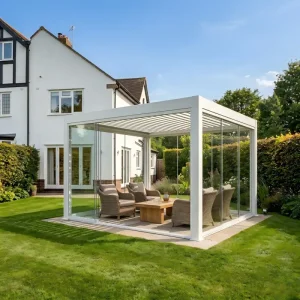
Vietnam Resort Spec: Custom Modern 175 Series Pergola with 90° Adjustable Louvers
Explore System Specs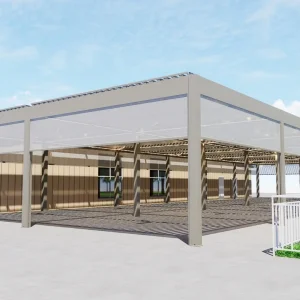
Architectural Kits: Customizable Modular Aluminum Pergola for Vietnam Projects
Explore System Specs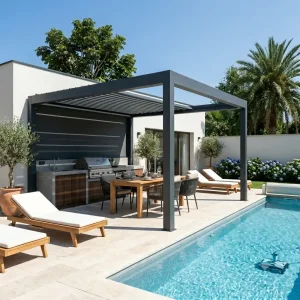
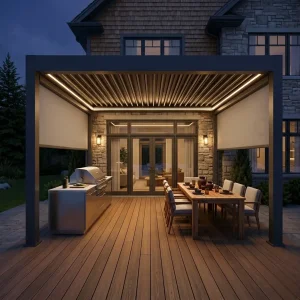
Luxury Residential: Louvered Aluminum Pergola for Premium Outdoor Kitchens
Explore System Specs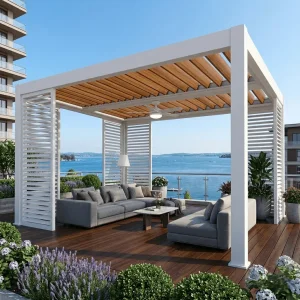
Coastal Vietnam: Wholesale 220 Series Hurricane-Rated Extreme Load Pergola
Explore System Specs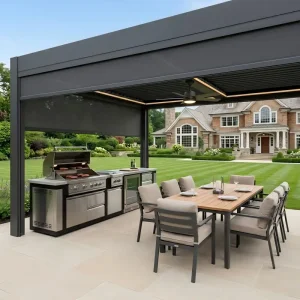
Heavy-Gauge 220mm Louvered Pergola: Engineered for Zero-Callback Projects
Explore System Specs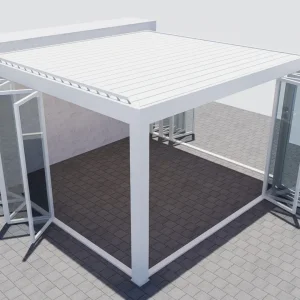
Four-Season Vietnam Enclosure: Modern Aluminum Pergola with Sliding Glass Doors
Explore System Specs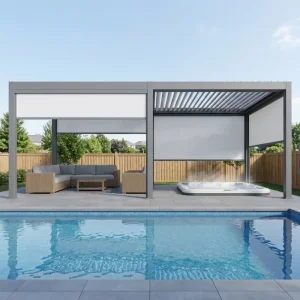
Vietnam Hospitality: Motorized Windproof Shading Tracks for Outdoor Kitchens
Explore System Specs