
Priority Retractable Pergola Systems for Moroccan Hospitality & Luxury Estates
Engineered using ultra-dense 6063-T6 aluminum alloys and precision Somfy motorized drives, these four flagship models provide rapid deployment for Moroccan resort renovations, seaside decks, and commercial urban terraces.
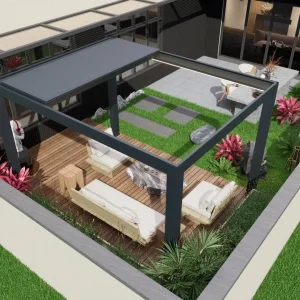
Morocco High-End Dual-Motor Retractable Pergola System
View Moroccan Spec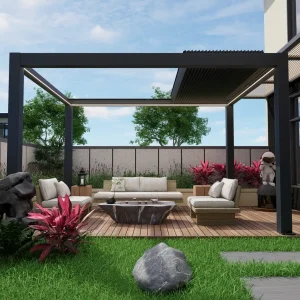
Commercial Aluminum Retractable Canopy for Casablanca Dining Terraces
View Moroccan Spec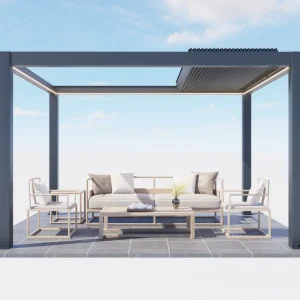
Architectural Minimalist Retractable Pergola for Marrakech Riads & Villas
View Moroccan Spec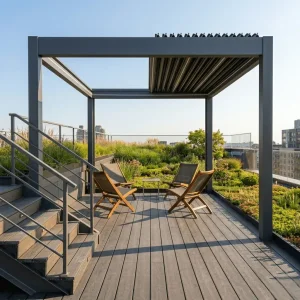
Commercial Grade 180-Series Heavy Retractable Structure for Tangier Resorts
View Moroccan SpecThe Moroccan Outdoor Living Transformation: Mega-Events & Urban Expansion
A deep architectural evaluation of market forces reshaping commercial real estate, luxury hospitality development, and outdoor dining across the Kingdom of Morocco.
Morocco is experiencing an unprecedented architectural evolution. Driven by national economic roadmaps and the monumental preparations for the 2030 FIFA World Cup (co-hosted with Spain and Portugal), public and private investments are flooding the hospitality, leisure, and upscale residential construction sectors. Institutional hotel operators in Marrakech, Casablanca, Tangier, Rabat, and Agadir are under immense competitive pressure to optimize every square meter of usable footprint, converting unshaded outdoor terraces into high-revenue year-round hospitality lounges.
In the North African commercial food-and-beverage (F&B) sector, RevPASH (Revenue Per Available Seat Hour) is strictly limited by extreme climatic fluctuations. During summer, unmitigated solar radiation creates thermal discomfort that empties open-air patios between 11:00 AM and 5:00 PM. Conversely, seasonal Atlantic storms and desert-influenced cool winter evenings render unroofed spaces completely unviable. Traditional permanent concrete overhangs create dark, uninviting interiors and require protracted municipal zoning permits, while flimsy fabric awnings fail prematurely under violent gusts. Motorized, architectural-grade retractable pergolas provide the definitive answer: full kinetic adaptability, deploying instant waterproof shading during intense sun and retracting effortlessly to celebrate starlit Mediterranean skies.
Hospitality Revenue Monetization
Moroccan rooftop venues in Casablanca's Gauthier district and Marrakech's Hivernage achieve up to a 68% uplift in banquet and dining table turnover by installing automated retractable enclosures paired with integrated LED systems.
Luxury Residential Riads & Villas
Architects restoring historic medina courtyards or designing sprawling contemporary villas in Casablanca’s Anfa require retractable glass and bioclimatic roof elements that offer shade without breaking vernacular geometry.
Extreme Climatological Resilience
From the corrosive saline mist along the Tangier Strait to the dry, dust-laden Chergui (Sirocco) winds originating in the Sahara, structures must withstand rigorous microclimates without structural fatigue or mechanical seizure.
Localized Moroccan Application Scenarios: Microclimates & Architectural Typologies
A single technical specification cannot serve Morocco's diverse bioregions. Our factory customizes metallurgy, structural anchorage, and automated sensors to meet exact territorial demands.
| Moroccan Region & City | Environmental Challenges | System Architecture Recommendation | Factory Technical Customization |
|---|---|---|---|
| Atlantic Coastline (Casablanca, Rabat, Mohammedia) |
Heavy humidity, persistent salt fog, ISO 9223 C4/C5 atmospheric corrosivity. | 180-Series Retractable Pergola with Integrated Side Zip Blinds. | Qualicoat Seaside Class 2 architectural powder coating (60-80μm), 316 stainless steel mechanical fasteners, hermetic motor casings. |
| Northern Mediterranean Gate (Tangier, Tetouan, Tanger Med) |
Violent maritime wind channels through the Strait of Gibraltar; cyclic gust loading. | Heavy-Duty Reinforced Beam Profiles with Continuous Internal Steel Core. | Reinforced 3.0mm primary wall extrusion, dual-pin hinge anchor plates, high-tensile multi-point drive transmission belts. |
| Inland Semi-Arid Plains (Marrakech, Fez, Meknes) |
Extreme diurnal temperature shifts (0°C winter nights to 48°C summer), Saharan Chergui sandstorms. | Full Bioclimatic Dual-Layer Retractable Fabric / Insulated Blade Hybrid. | Anti-abrasive PVDF surface coating to resist micro-sand erosion, thermal expansion expansion-joints, integrated automated dust/wind sensors. |
| High Atlas Elevations (Ifrane, Oukaïmeden, Midelt) |
Sub-zero freeze-thaw cycles, winter snow deposition (up to 120 kg/m²). | High-Pitch Retractable System with Integrated Concealed Drainage Heating. | Internal heated gutter elements to prevent ice damming, heavy-gauge beam deflection tolerances adhering strictly to Eurocode 9. |
In historical medina contexts, such as the UNESCO-protected riads of Fez and Marrakech, retractable pergolas perform an essential bioclimatic role. Traditional riads feature an open central atrium (patio) that functions as a natural ventilation chimney. However, winter downpours cause cold air to settle at the ground level, while extreme summer sun turns the courtyard into an oven. By installing our custom sleek motorized retractable systems at the atrium roof level, riad boutique hotels maintain a stable interior microclimate year-round, protecting antique cedar woodwork and zellige mosaic tiling while drastically reducing electric HVAC bills.
Global Commercial Dynamics: The Rise of Kinetic Bioclimatic Pergola Systems
The worldwide commercial outdoor shading market is expanding at a CAGR of 7.4%, rapidly transforming from ornamental structures into dynamic building-envelope performance assets.
Globally, the architectural paradigm has shifted from passive shading elements (like canvas umbrellas and stationary wooden gazebos) to dynamic bioclimatic building skins. Commercial developers in Monaco, Dubai, Miami, and now Morocco, evaluate outdoor structures not merely as decorative landscaping, but as active components of the building’s thermal performance and operational profitability.
When properly engineered and positioned, an automated retractable pergola can reduce direct solar heat gain on adjacent building glazing by up to 78%, slashing mechanical cooling loads during peak hours. In forward-thinking hotel resorts pursuing international certifications such as LEED (Leadership in Energy and Environmental Design) or HQE (Haute Qualité Environnementale), these smart kinetic envelopes contribute directly to Energy & Atmosphere credits by dynamically modulating solar admittance throughout the diurnal cycle.
Thermal Envelope Integration
Kinetic retractable louvers act as dynamic thermal baffles. By managing thermal mass and solar gain along glass facades, building energy consumption drops significantly during severe heatwaves.
Zero-Structural Maintenance Lifespan
Unlike wood, which rots and warps under UV radiation, or mild steel, which oxidizes rapidly in marine air, structural aluminum 6063-T6 provides a maintenance-free 25+ year design lifespan.
Smart Automation & BMS Compatibility
Contemporary commercial installations integrate directly with centralized Building Management Systems (BMS) through Modbus, KNX, or Zigbee protocols for autonomous climate-reactive operations.
Direct-From-Factory Supply Chain: Foshan Aluminum Precision for Moroccan Importers
How our vertically integrated production infrastructure in China's industrial aluminum epicenter provides Moroccan contractors with unmatched price-to-performance, strict tolerances, and agile logistics.
Moroccan contractors and distributors have traditionally relied on European fabricators in Spain, Italy, or France for motorized shading systems. However, this procurement route carries severe commercial disadvantages: European fabricators frequently source raw extrusions externally, mark up finished units by 150-200%, and enforce inflexible 10-to-14-week lead times. For fast-track projects in Morocco, such bottlenecks jeopardize completion dates and compress contractor profit margins.
Operating from Foshan, China’s industrial aluminum capital, our manufacturing facility delivers direct-to-site engineering excellence with full vertical integration. From primary ingot smelting and precision die extrusion to high-speed 5-axis CNC machining, automated horizontal powder coating, and pre-shipment dry-fit testing, every operation is managed strictly in-house.
Alloy Purity & Structural Profiles
We use exclusively 100% virgin 6063-T6 billet aluminum (AlMg0.7Si), avoiding recycled industrial scrap. This guarantees tensile strength ≥ 215 MPa and yield strength ≥ 170 MPa, eliminating micro-fissuring under heavy loads.
Automated Surface Passivation
Profiles undergo a 7-stage chemical pre-treatment and chrome-free zirconium passivation before electrostatic application of AkzoNobel or Tiger Drylac architectural powders, backed by a comprehensive 15-year gloss retention warranty.
Rapid Production Velocity
Standard architectural configurations are manufactured and packaged within 14-18 business days. With scheduled direct sailings from Guangzhou and Shenzhen to Port Tanger Med, transit requires just 24-28 days.
Engineering Roadmap: The Future of Intelligent Outdoor Living (2025–2030)
Our R&D division is actively testing and deploying next-generation shading technologies designed to seamlessly interface with future Moroccan sustainable city projects.
BIPV Solar Photovoltaic Integration
Thin-film monocrystalline PV cells seamlessly laminated onto retractable aluminum louvers. Generating up to 140W per square meter of pergola area, transforming shading structures into off-grid decentralized charging hubs for luxury eco-resorts.
Microclimate AI-Sensor Matrix
Autonomous weather station arrays equipped with infrared optical rain detectors, digital anemometers, and thermodynamic ambient trackers. The system automatically adjusts blade angle or retracts fabric ahead of localized microbursts.
Hydrophobic Self-Cleaning Nanotech
Super-hydrophobic ceramic clear coats that utilize morning condensation and light rainfall to sheet away fine desert dust particulates, eliminating manual cleaning schedules on expansive hotel terrace roofs.
Moroccan Compliance, Customs Clearance & Site Engineering Support
We de-risk cross-border procurement through complete technical documentation, standardized Eurocode validation, and reliable logistics right to your Moroccan warehouse or project site.
Executing architectural projects across Morocco requires rigorous attention to import compliance, technical standardization, and on-site assembly logic. Our dedicated international project management team provides turn-key documentation packages that streamline clearance through Moroccan Customs Administration (ADII) and simplify local building approvals:
Structural Eurocode Validation
Engineering verification adhering to Eurocode 9 (EN 1999-1-1: Design of Aluminum Structures) and Eurocode 1 (Actions on Structures), complete with structural load calculation sheets ready for review by Moroccan engineering inspection bureaus (Bureau de Contrôle like Socotec or Veritas).
Port Tanger Med & Casablanca Shipping
Direct maritime routing via major ocean carriers (CMA CGM, Maersk, COSCO) directly into Port Tanger Med or Casablanca Commercial Port. All cargo is packed inside fumigated, reinforced export crates with waterproof plastic wrapping and edge protectors.
Contractor CAD & BIM Asset Delivery
Every commercial order is accompanied by customized 3D Revit (.RVT) families, IFC files, and detailed step-by-step 2D CAD assembly schematics with numbered profiles, enabling local Moroccan installation crews to erect structures cleanly and without field modification.
Engineering-Grade Retractable & Structural Pergola Systems
Explore our complete heavy-duty 180-Series and architectural configurations, engineered to supply commercial hotel developers, distributors, and high-end residential builders throughout Morocco.
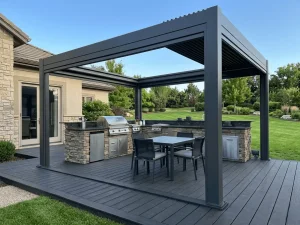
Morocco Luxury Villa 180-Series Motorized Pergola System
View Product Specs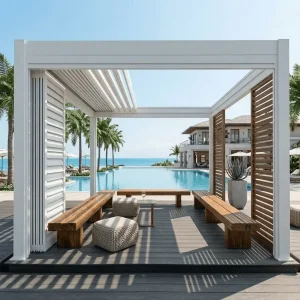
Contractor-Grade 180-Series Heavy Aluminum Pergola Framework
View Product Specs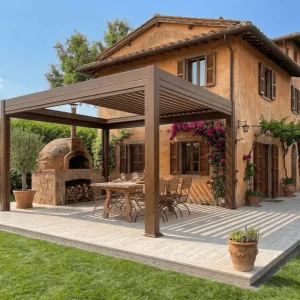
Outdoor Hospitality & Culinary Retractable Shield System
View Product Specs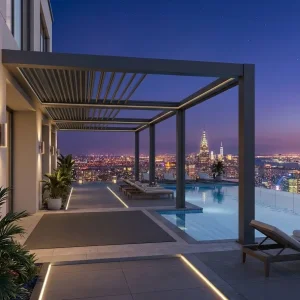
High-Margin 180-Series Pergola for Moroccan B2B Importers
View Product Specs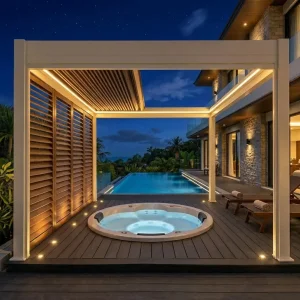
Revenue-Optimized Retractable Solution for High-Traffic Resorts
View Product Specs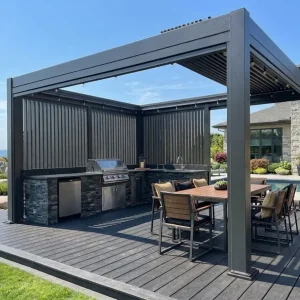
Permanent Structural Retractable Pergola for Coastal Estates
View Product Specs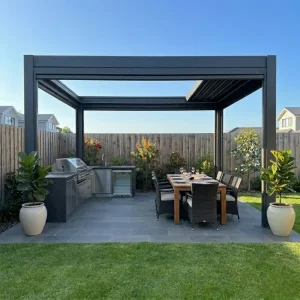
Heavy-Duty Spec Aluminum Pergola for Urban Moroccan Developers
View Product Specs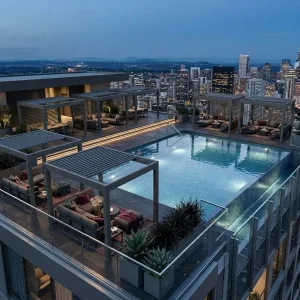
High-Load Rooftop Architectural Pergola for Commercial Sky-Lounges
View Product SpecsFrequently Asked Questions for Moroccan Contractors, Importers & Architects
Crucial guidance on metallurgical resilience, customs clearance under Moroccan trade frameworks, structural tolerances, and on-site assembly.
How do your aluminum retractable pergolas withstand coastal corrosion in Casablanca and Tangier?
What is the shipping procedure and transit time to Moroccan ports (Tanger Med / Casablanca)?
Can Moroccan architectural firms request custom RAL colors and private-label branding?
How do the automated motor drives and mechanical tracks hold up against Saharan Chergui sandstorms?
What structural engineering documentation is provided for local Moroccan building approval?
Can your pergola systems integrate glass sliding doors and motorized zip screens simultaneously?
Initiate Your Moroccan Architectural Shading Project Today
Direct factory engineering consultation, detailed CAD drawings, and comprehensive B2B commercial quotes for Moroccan developers, hotel chains, and distributors. Partner directly with an experienced Foshan manufacturer.