
High-Performance Motorized Architectural Roller Systems
Direct supply for Korean electrical contractors, curtain-wall engineers, and commercial facility developers demanding precision fabrication, Matter-protocol IoT integration, and low-thermal-bridging components.
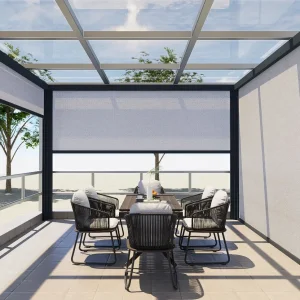
Korea Smart Commercial: Wholesale Electric Roller Blinds
View Specifications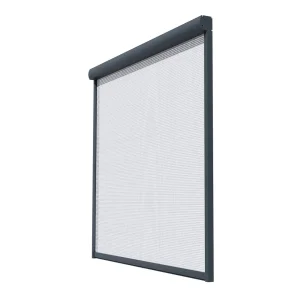
Korean Multi-Zone: Custom Premium Electric Roller Blinds
View Specifications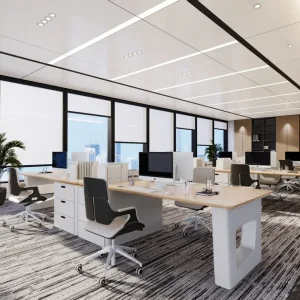
Korea Residential Elite: Wholesale Electric Roller Blinds
View Specifications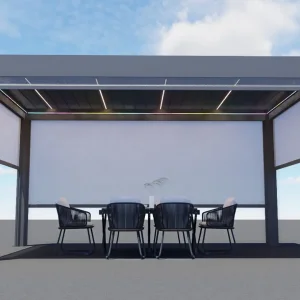
Korea Enterprise: Wholesale Advanced Motorized Roller Blinds
View SpecificationsThe Korean Architectural Shading & Fenestration Landscape
Analyzing zero-energy building standards (ZEB), extreme meteorological challenges, and the rapid shift toward intelligent fenestration across South Korea.
Macro-Industrial Dynamics: Republic of Korea's Regulatory & Climatic Imperatives
The Republic of Korea stands as one of the world's most demanding testbeds for advanced architectural facade engineering. Under the revised Green Buildings Construction Support Act enacted by the Ministry of Land, Infrastructure and Transport (MOLIT), zero-energy building (ZEB) mandates are no longer voluntary guidelines; they are strict procurement prerequisites for both public sector facilities and residential complexes exceeding 30 households. In modern metropolitan dense corridors—ranging from Seoul's Teheran-ro financial district to the maritime urban developments of Incheon Songdo and Busan Marine City—massive low-e glass curtain walls present acute thermal and optical management challenges. Internal cooling loads spike excessively during East Asia's subtropical monsoon summer, while harsh continental Siberian winter winds demand dynamic envelope insulation.
Standard interior blinds have reached their physical limits. Architectural firms and Tier-1 general contractors (such as Hyundai E&C, Samsung C&T, and GS E&C) are systematically shifting specifications toward external zip-guided dynamic roller systems and thermal-break interior roller blinds. The primary objective is controlling the total solar heat gain coefficient (SHGC or g-tot). By deflecting up to 88% of solar radiation before it breaches the glazed perimeter, motorized exterior roller screens effectively suppress the greenhouse effect within high-rise structural glazing, eliminating localized HVAC overload and mitigating disruptive glass thermal shock stress.
Typhoon-Grade Structural Track Design
Southern coastal installations (Busan, Jeju, Yeosu) routinely experience extreme gusts during typhoon seasons exceeding 45 m/s. Our patented heavy-gauge extruded side channels with co-extruded TPU impact damping secure zip fabrics without derailment or tearing.
KS C 8305 Standard Compliance
Our tubular drives are matched to South Korean electrical requirements (220V/60Hz), featuring integrated surge protective devices (SPD) to protect against grid transients, alongside KC-certified RF receivers and dry-contact automation interfaces.
High-Density Living Acoustic Damping
With apartment residential models (Officetels and Raemian/Acro complexes) dominating Korean housing, planetary gearmotors are acoustically insulated inside silicone suspension couplings, maintaining operating decibel levels below 32 dB(A).
Global Shading Paradigms vs. Localized Korean Application Matrix
Across Europe and North America, solar shading primarily focuses on glare management and basic mechanical durability. However, importing off-the-shelf Western systems into South Korea without re-engineering frequently leads to field failures. The reasons lie in distinct structural paradigms: Korea's high-rise residential towers deploy composite reinforced concrete cores wrapped in unitized aluminum curtain wall profiles with internal subframes. Standard anchoring mechanisms cause thermal bridging, leading to severe winter condensation issues when interior temperatures are kept warm via traditional floor radiant heating (Ondol).
Our manufacturing line integrates custom mounting brackets featuring polyamide thermal breaks and stainless-steel AISI 316 anchoring brackets. Below is a detailed engineering comparative assessment highlighting our technical positioning across key operational metrics:
| Engineering Attribute | Standard Imported Commercial Blinds | Conventional Local Korean Blinds | Summer Heaven Korean-Spec Solutions |
|---|---|---|---|
| Wind Resistance Index | Beaufort Scale 4 (Up to 28 km/h) | Beaufort Scale 5 (Up to 38 km/h) | Beaufort Scale 10-12 (Up to 120 km/h with Zip Lock) |
| Solar Glare & g-tot Value | g-tot ~ 0.28 (Internal screen) | g-tot ~ 0.35 (PVC standard yarn) | g-tot < 0.10 (Exterior Fiberglass/Endaco PVDF core) |
| Fire Safety Compliance | NFPA 701, DIN 4102 B1 | KOFEIS Fire Safety Standard | Dual Match: KOFEIS-Certified Flame Retardant & Class A ASTM |
| Building Automation Interface | Proprietary RF / Single RS485 | Local Wall Switch / Basic RF | Matter, BACnet, Modbus, KNX, Zigbee 3.0 & Dry Contact |
| Thermal Bridging Elimination | Direct mechanical screw mount | Direct bracket anchor to window sash | Polyamide PA66 thermal isolate brackets with gasket seals |
Localized Compliance, Material Longevity & Environmental Resilience
Korean coastal cities and high-tech industrial hubs (Pyeongtaek, Ulsan, Gwangyang) possess atmospheres characterized by elevated chloride ion content combined with particulate pollution (fine dust PM2.5/PM10). Standard polyester screen fabrics degrade rapidly under this photochemical smog and marine salt fog, suffering from plasticizer embrittlement, optical yellowing, and edge fraying.
To ensure reliable multi-decade life cycles, Summer Heaven utilizes yarn composed of individual fiberglass filament cores double-coated in anti-microbial, halogen-free polyvinylidene fluoride (PVDF) or composite polyester polymers. The yarn undergoes rigorous salt-spray testing exceeding 1,500 hours (ASTM B117) and Xenon arc UV radiation weathering tests (ISO 4892-2) without mechanical degradation. Furthermore, all structural aluminum extrusions are produced from high-grade 6063-T6 architectural alloys treated with 25-micron Qualicoat Class 2 architectural powder coating, protecting against the galvanic corrosion typically encountered when blinds meet structural building mullions.
High-Resistance Heavy-Duty Exterior Motorized Zip Screens
Engineered to withstand Korean typhoon forces, winter coastal storms, and intense heat island solar loads. Fully compatible with aluminum pergolas, curtain walls, and commercial open-terrace configurations.
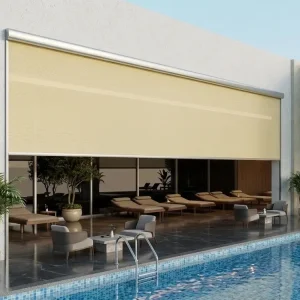
Korea Marine: Custom Heavy-Duty Motorized Zip Screens
View Specifications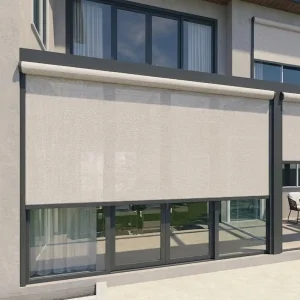
Korea Architectural: Custom Beyond Shading Zip Screens
View Specifications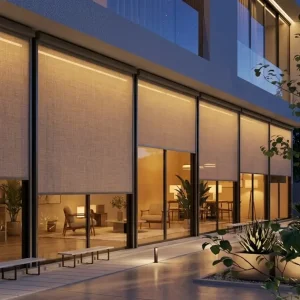
Korea Facades: Custom High-Performance Zip Screens
View Specifications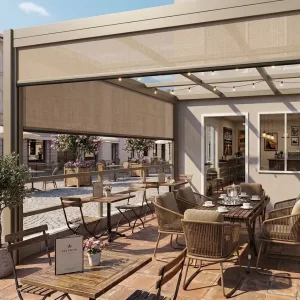
Korea Hospitality: Windproof Zip Screens for Terraces
View Specifications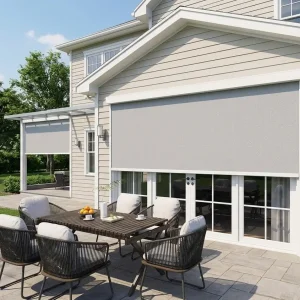
Korea Coastal: Wholesale Extreme Weather Zip Screens
View Specifications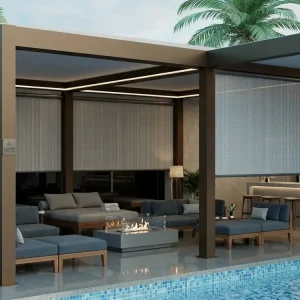
Korea Pergola Line: Motorized Zip Screen Enclosures
View Specifications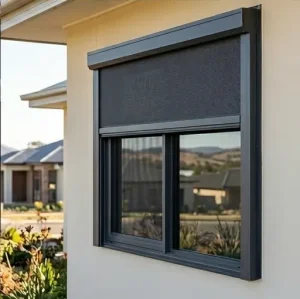
Korea Commercial: Patio Climate Control Zip Screens
View Specifications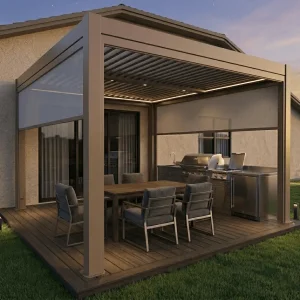
Korea Residential: Motorized Patio Windproof Screens
View SpecificationsNext-Generation Technology Roadmap for Korean Smart Cities
Aligning solar control engineering with the evolution of South Korea's autonomous buildings, BMS protocols, and high-efficiency bioclimatic facades.
Matter & Smart Home Native Fabrics
By integrating direct Matter-over-Thread communication chips within internal tubular motors, our systems communicate natively with Samsung SmartThings, Apple Home, and LG ThinQ without bridging gateways, providing seamless end-user scene triggers.
Photovoltaic BIPV Micro-Weave Coatings
Our ongoing R&D encompasses thin-film flexible organic photovoltaic (OPV) cell integration on exterior fiberglass mesh. These screens not only prevent internal HVAC solar spikes but harvest sufficient micro-currents to power decentralized motor mechanics.
Sun-Tracking Predictive AI Automation
Deploying astronomical solar ephemeris algorithms tied with localized weather radar APIs, our commercial facade blinds automatically adjust their height throughout the workday to block direct beam solar heat while maximizing natural, diffuse daylighting.
Frequently Asked Questions for Korean Projects
Direct technical answers regarding customs clearing, structural certifications, logistics, and on-site engineering support.
How do your motorized roller blinds comply with South Korea's Fire Protection regulations? +
Can your tubular motors be integrated into local Korean home automation systems like Samsung SmartThings? +
What is the maximum wind resistance rating for exterior zip screens installed on high-rises? +
How are international shipments handled for Korean ports such as Busan or Incheon? +
Do you manufacture custom-dimension systems tailored to existing CAD architectural drawings? +
Initiate Your Korean Architectural Project
Connect with our technical shading engineers. We supply detailed product cut-sheets, thermal modeling data, fabric swatches, and competitive factory-direct supply terms for Korean developers, general contractors, and distributors.
Send Inquiry Now