
High-Performance Motorized Roller Blinds for the Japanese Market
Engineered for high-density metropolitan offices, luxury residential towers, and low-energy ZEH builds. These 4 flagship motorized shade series combine ultra-quiet DC brushless motors with intelligent IoT protocol compatibility.
-
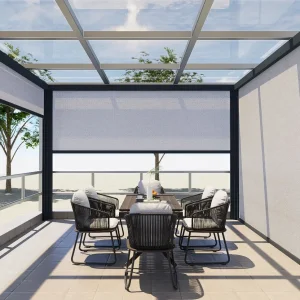 Tokyo Smart Towers
Smart Building Electric Roller Blinds for Commercial Architecture
-
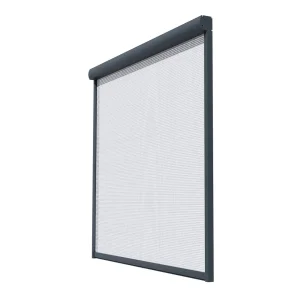 Total Solar Guard
Custom Premium Electric Blinds for Total Climate & Privacy Protection
-
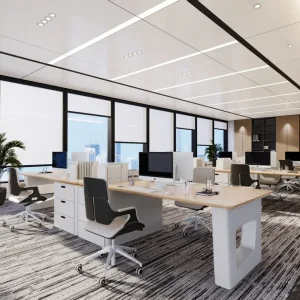 ZEH Residential
Acoustic Smart Electric Blinds for Minimalist Japanese Living Spaces
-
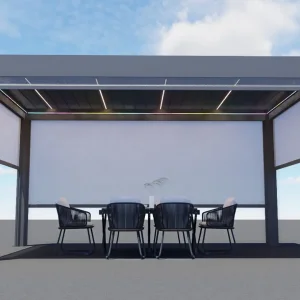 High-Rise Grade
Advanced Motorized Roller Blinds for Heavy-Duty Commercial Protection
The Architectural Shading Landscape in Modern Japan
Japan’s built environment represents one of the world's most sophisticated intersections of seismic safety, spatial minimalism, and stringent thermal efficiency mandates. Sourcing architectural roller shades for this market demands uncompromising attention to local regulatory standards and distinct spatial cultures.
Net-Zero Energy House (ZEH) Alignment
Under the Ministry of Land, Infrastructure, Transport and Tourism (MLIT) revised Energy Conservation Act, Japanese buildings must meet aggressive thermal envelope benchmarks. Exterior and interior solar shading systems drastically suppress Solar Heat Gain Coefficient (SHGC), directly reducing cooling HVAC loads during peak summer heatwaves.
Stringent Fire Service Act Compliance
All roller fabrics deployed in commercial facilities, hospitality, medical institutions, and high-rise structures exceeding 31 meters must possess strict fireproof registration. Our fabrics comply with JIS L 1091 flameproof standards and undergo rigorous limiting oxygen index (LOI) combustion evaluations.
Typhoon & Seismic Structural Resilience
Exterior zip screens and roller enclosures installed along Japanese coastal regions or high-wind valleys (Kantō and Kansai corridors) must endure sustained Beaufort Scale wind pressures. Our zipper tracks utilize high-grade extruded 6063-T6 aluminum to withstand extreme lateral wind shear.
Foshan Extrusion Strength Combined with Japanese Precision Tolerances
Headquartered in China’s prime industrial manufacturing corridor, our production facilities leverage the world’s most comprehensive supply ecosystem for metallurgical engineering, surface finishing, and automation components. For Japanese trading houses (Sogo Shosha), architectural contractors, and interior distributors, this operational synergy yields substantial commercial advantages.
Japanese procurement demands micrometer-level precision. In response, our automated CNC cutting lines, laser-guided fabric welders, and proprietary ultrasonic cutting tables maintain dimensional tolerances within ±0.5 mm, eliminating fabric fraying and edge curling over protracted lifecycle spans.
- Virgin 6063-T6 Aluminum Profiles: Superior surface anodization and multi-stage powder coating meeting architectural weathering requirements.
- PSE Certified Motor Drives: Complete electrical safety compliance for the Japanese 100V 50Hz/60Hz grid with certified noise decoupling.
- Formaldehyde Free (F☆☆☆☆ Level): Eco-friendly fabric compositions ensuring zero VOC off-gassing in sealed, airtight indoor environments.
| Engineering Parameter | Standard Global Export | Japan Custom Specification |
|---|---|---|
| Motor Voltage & Frequency | 220V - 240V / 50Hz | 100V / 50Hz (East) & 60Hz (West) PSE Certified |
| Flame Retardant Standard | NFPA 701, DIN 4102 B1 | JIS L 1091 A-1 / A-2 Flameproof Certification |
| Formaldehyde & VOC | RoHS / REACH Standard | F☆☆☆☆ Compliant / JIS A 1460 Desiccator Test |
| Sound Pressure (Operating) | ≤ 44 dB(A) | ≤ 30-32 dB(A) Brushless Silent Motors |
| Fabric Dimensional Stability | ± 2.0 mm / linear meter | ± 0.5 mm Ultrasonic Calibrated Sealing |
Localized Application Scenarios Across Japan’s Prefectures
From Tokyo’s commercial skyscrapers to Kyoto’s preserved historical districts, architectural shading must harmonize with nuanced building frameworks, ambient lighting requirements, and regional microclimates.
Grade-A Office Towers (Marunouchi & Roppongi)
Large-format glazed curtain walls demand unified automated solar control. Integrated via BACnet or Modbus into centralized Building Management Systems (BMS), motorized blinds auto-adjust following sun angles, reducing cooling surges while maintaining outdoor panoramic clarity without optical distortion.
Machiya & Luxury Ryokan Renovations (Kyoto & Hakone)
Traditional wood-framed heritage properties require discreet, zero-intrusion motor cassette housings. Ultra-compact headboxes (65 mm to 85 mm) concealed behind cedar soffits provide modern thermal insulation and complete blackout capability without compromising traditional Wabi-Sabi wooden aesthetics.
Waterfront Condominiums & Coastal Cafés (Tokyo Bay & Okinawa)
Subjected to salt spray, dense humidity, and sudden maritime gales, exterior patio zip screens utilize marine-grade 316 stainless steel fasteners and C5-M rated fluoropolymer powder coating, creating all-weather outdoor dining zones that boost operational commercial floor area year-round.
Emerging Trends Reshaping the Shading Industry in Japan
The convergence of artificial intelligence, IoT home ecosystems, and high-efficiency bioclimatic materials is redefining market expectations across Japan’s architectural contracting sphere.
1. Matter & Zigbee 3.0 Standardized Automation
Proprietary RF protocols are rapidly yielding to universal smart home standards. Japanese multi-family apartment developers now specify Matter-compliant and Zigbee 3.0 tubular motors. This enables native integration with Apple Home, Google Assistant, Amazon Alexa, and regional Japanese home automation platforms without cumbersome third-party bridges.
2. Low-E Solar Reflective Metallized Textiles
Modern commercial buildings with west-facing glazed facades require severe glare mitigation. Vacuum-metallized aluminum-backed fabrics reflect up to 78% of incoming solar infrared radiation back through the glazing before it converts to ambient internal heat, preserving optical transparency and natural daylighting.
3. Bioclimatic Zip Screens for Sustainable Urbanism
Japanese urban planners are prioritizing open-air social spaces that mitigate the urban heat island effect. Motorized zip screens acting as dynamic vertical exterior envelopes protect terrace dining spaces against sudden rain squalls and seasonal pollen, driving tangible revenue increments for Japanese restaurateurs.
4. Circular Economy & Recycled PET Yarns
With corporate ESG reporting becoming mandatory for Tokyo Stock Exchange Prime-listed corporations, architectural specifications favor PVC-free, cradle-to-cradle certified fabrics spun from 100% post-consumer recycled plastic bottles, drastically lowering the embodied carbon footprint of major real estate developments.
All-Weather Exterior Roller Blinds & High-Performance Zip Screens
Engineered for high wind resistance, facade weatherproofing, and large-span commercial perimeters. Discover our 8 specialized exterior motorized systems designed for Japanese climatic conditions.
-
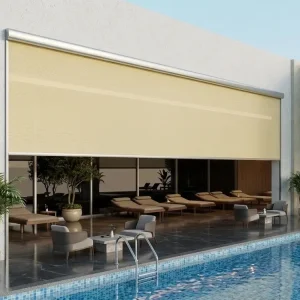 Typhoon Resistant
Heavy-Duty Motorized Zip Screens for High-Performance Outdoor Environments
-
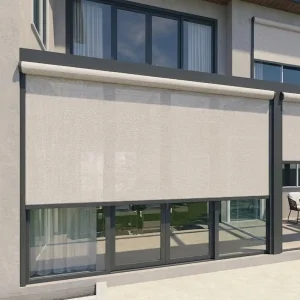 All-Weather Enclosure
All-Weather Living Room Zip Screens for Modern Japanese Terraces
-
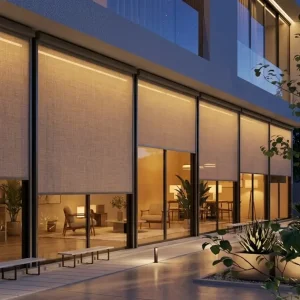 Architectural Facades
High-Performance Zip Screen Solutions for Architectural Outdoor Facades
-
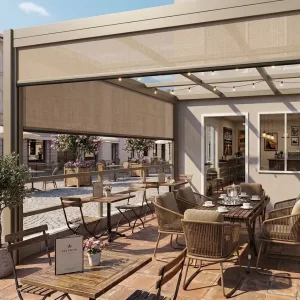 Hospitality Seating
Commercial Windproof Zip Screens for Restaurant & Café Outdoor Seating
-
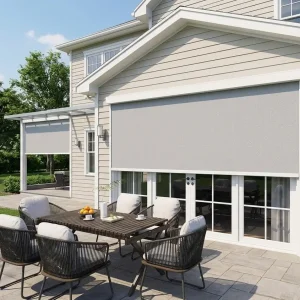 Extreme Perimeter
Extreme Weather Windproof Zip Screens for Coastal & Elevated Structures
-
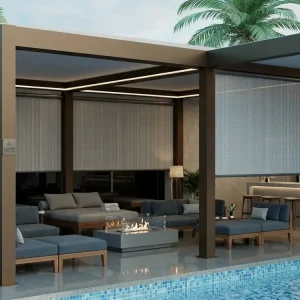 Pergola Modular
Motorized Zip Screen Enclosures for Aluminum Pergolas & Pavilions
-
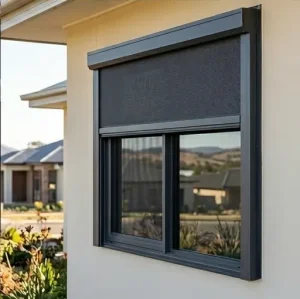 Microclimate Control
Motorized Exterior Zip Screens for Commercial Patio Climate Control
-
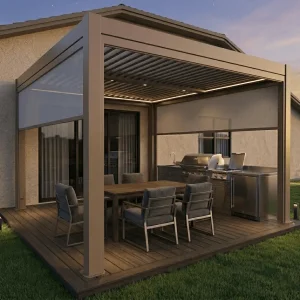 Residential Courtyard
Motorized Patio Zip Screens for Windproof Residential Backyard Shading
Frequently Asked Questions for Japanese Project Buyers
Clear, direct answers regarding electrical safety standards, Japanese building codes, minimum order quantities (MOQ), sample verification, and cross-border containerized shipping.
Yes. We supply tubular and external motors certified with the PSE mark (Product Safety Electrical Appliance & Material). Our motors operate reliably at both 100V 50Hz (Eastern Japan, including Tokyo) and 100V 60Hz (Western Japan, including Osaka and Nagoya), with dedicated thermal overload protection.
Our commercial fabrics are tested in accordance with JIS L 1091 (Testing Methods for Fire Retardancy of Textiles) and can be issued with formal test certificates accepted by local fire inspection authorities. They meet the strict flammability criteria required for commercial facilities, offices, and mid-to-high rise residential developments.
Absolutely. In addition to our standard architectural anodized silver, matte black, and pure white profiles, we provide custom electrostatic powder coating matched to any international RAL color or Japan Paint Manufacturers Association (JPMA) color code. Custom cassette profiles can be machined to fit narrow or recessed window heads.
Standard fabrication lead time is 15 to 25 business days depending on order volume and custom powder-coating requirements. Sea freight transit from South China (Nansha/Yantian/Hong Kong) to major Japanese ports (Tokyo, Yokohama, Osaka, Kobe) takes only 3 to 6 days, ensuring rapid inventory replenishment for contractors.
We supply comprehensive CAD cross-sections, 3D BIM models, exploded mounting diagrams, and wire-routing schematics prior to production kickoff. Each unit is labelled according to your architectural floor and window schedules, allowing jobsite installers to unpack and mount with zero confusion.
Yes. Many of our Japanese commercial clients consolidate interior motorized roller blinds, exterior windproof zip screens, and bioclimatic louvered pergolas into a single 20GP or 40HQ container, significantly reducing logistics tariffs, port handling fees, and domestic warehouse staging overheads.
Initiate Your Japanese Project Consultation
Partner with an established architectural manufacturer delivering certified precision, robust supply chain resilience, and rapid delivery schedules directly serving Tokyo, Osaka, and nationwide job sites.