
Primary Architectural Pergola & Retractable Screen Series
Engineered specifically to withstand high solar UV indexes in northern Mexico and corrosive maritime humidity along the Caribbean and Pacific resort coastlines.
Mexico's Commercial Landscape & Architectural Demand
The convergence of nearshoring capital inflow, high-end hospitality real estate, and extreme tropical-to-arid microclimates is accelerating procurement of modular bioclimatic exterior envelopes.
Mexico has evolved into one of the most dynamic architectural and commercial development arenas in the Western Hemisphere. Driven by structural real estate transformations—predominantly the expansive nearshoring wave across the Bajío and northern industrial states (Nuevo León, Coahuila, Chihuahua) alongside persistent, multi-billion-dollar luxury hospitality investments across Quintana Roo, Baja California Sur, Nayarit, and Oaxaca—the requirement for modular, high-durability exterior shading and environmental protection envelopes has surged exponentially.
Architects, corporate general contractors, and resort operators across Mexico are systematically abandoning traditional timber pergolas, fixed fabric canopies, and non-engineered steel awnings. The operational reality of Mexico's microclimates presents significant engineering hurdles:
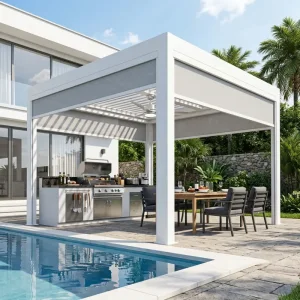
Commercial developers require multi-functional exterior rooms. A standard open-roof arbor provides negligible commercial utility during heavy seasonal rains or peak midday solar radiation. Modern B2B procurement in Mexico mandates a fully integrated exterior system: bioclimatic motorized roof louvers integrated seamlessly with automated windproof zip screens (shades), acoustic composite or aluminum louvered walls, and frameless panoramic sliding glass doors. This unified envelope converts outdoor hospitality patios, rooftop executive lounges, and residential verandas into revenue-generating, climate-controlled spaces operable 365 days a year.
Hospitality Revenue Maximization
Resort properties in Cancun, Tulum, and Cabo San Lucas achieve up to 35% higher food and beverage seat turnarounds by deploying waterproof motorized pergolas with windproof side screens that deploy automatically when tropical convective showers strike.
Corporate Nearshoring Campus Demands
Multinational operations establishing manufacturing facilities in Monterrey, Querétaro, and San Luis Potosí are heavily integrating open-air, covered executive pavilions, employee dining courtyards, and biophilic recreation modules that require sound-insulating wall systems.
Severe Maritime & Thermal Resistance
Eliminating regular timber maintenance, rust, and premature structural failure. Architectural 6063-T6 aluminum alloys coated with AkzoNobel Interpon D2525 fluorocarbon powder withstand over 3,000 hours of continuous salt-spray exposure without blistering.
Evolution of the Bioclimatic Envelope: Shades, Walls & Doors
The technological leap from simple standalone canopies to multi-layered, hermetically engineered architectural living cells.
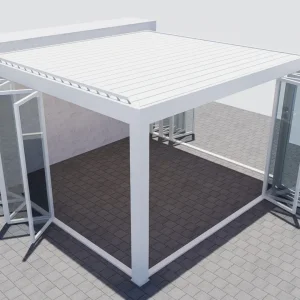
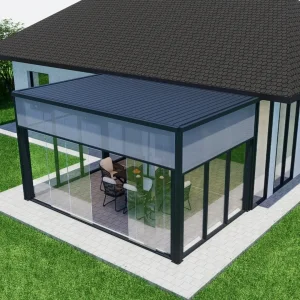
The contemporary pergola is no longer an ornamental landscape element; it has transformed into a high-precision, load-bearing architectural envelope. Through the synchronized integration of mechanical shading, modular acoustic barrier walls, and tempered architectural glazing, modern pergolas achieve full interior-exterior environmental balance.
1. Motorized Zip Screen Shading Integration
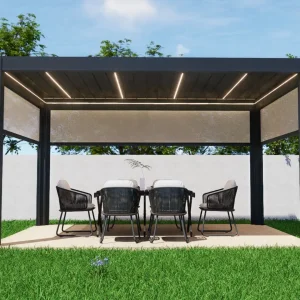
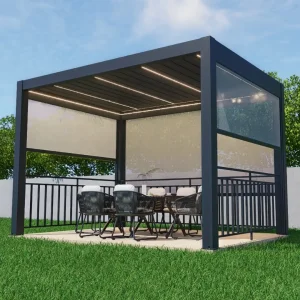
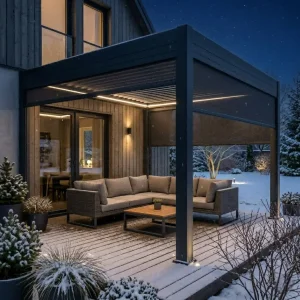
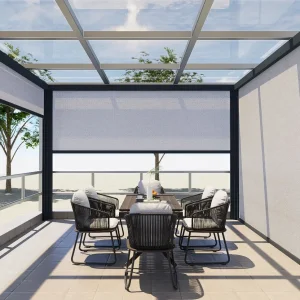
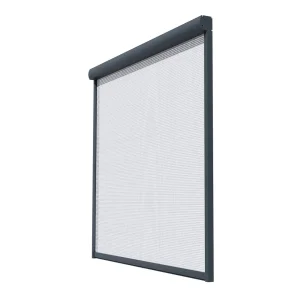
Modern side shading relies on deep-extrusion guide tracks engineered with welded PVC-zipper retention inserts. The fabric—typically a composite blend of PVC-coated high-tenacity fiberglass or polyester core yarn—remains permanently tensioned under high wind velocities (tested up to Beaufort scale 10-11). In Mexican coastal microclimates, these automated shades serve a dual role: eliminating over 90% of solar thermal infrared radiation (Solar Heat Gain Coefficient reduction) while maintaining natural outdoor cross-ventilation and preventing insect ingress without obstructing outward panoramic sightlines.
2. Fixed & Adjustable Louvered Perimeter Walls
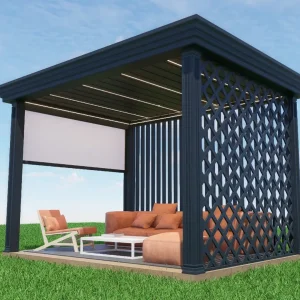
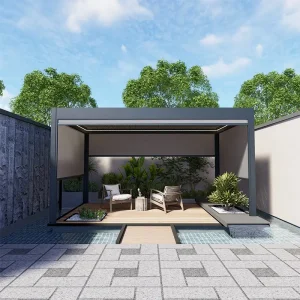
Where acoustic isolation, enhanced structural rigidity, or absolute visual privacy is required, modular aluminum wall assemblies are slotted directly into the post-and-beam structural chassis. Available as fixed vertical privacy battens, horizontal sun-shading louvers, or multi-core insulated sandwich panels, these walls anchor the pergola firmly against lateral wind loads while establishing defined perimeter zoning for luxury resort cabanas or corporate meeting pavilions.
3. Multi-Track Sliding & Bi-Folding Glass Doors
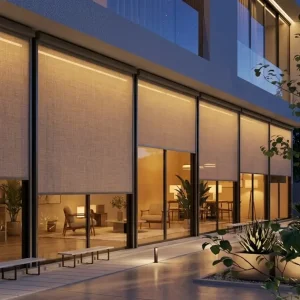
To deliver true all-season performance, pergolas are equipped with bottom-weighted, low-threshold sliding or folding glass systems utilizing 8mm to 12mm certified tempered or laminated security glass. Precision-machined stainless steel tandem rollers glide effortlessly along recessed flush floor tracks, offering airtight, water-resistant perimeter seals through multi-fin EPDM weatherstripping. During clear conditions, the panels stack cleanly to clear up to 85% of the opening width; during severe downpours or high-velocity windstorms, the system seals hermetically.
| System Module | Structural Specification | Wind Load Resistance | UV & Thermal Protection | Key Application in Mexico |
|---|---|---|---|---|
| Bioclimatic Louver Roof | Dual-layer hollow blade (175mm-220mm), 6063-T6 aluminum, 2.5mm-3.0mm wall thickness | Up to 180 km/h (closed) | 100% UV block; SHGC < 0.05 | Luxury hotel breakfast terraces, rooftop sky bars in CDMX & Guadalajara |
| Windproof Zip Screen Shades | Concealed zip-track guide rail, tubular motor with micro-obstacle sensing | Tested to 120 km/h | Up to 96% solar heat reflection, 1%-5% openness factor | Coastal wind reduction in Los Cabos, mosquito & glare barrier in Riviera Maya |
| Perimeter Louver/Acoustic Wall | Modular tongue-and-groove aluminum slats or PU-core acoustic sandwich infill | Continuous shear load barrier | Thermal barrier R-value up to 2.8 m²·K/W (insulated option) | Executive VIP cabanas, boundary privacy in residential Valle de Guadalupe estates |
| Panoramic Sliding Glass Door | Multi-track bottom-weighted track, 10mm-12mm toughened safety glass, EPDM seals | Static structural glass rating to 2.4 kPa | Acoustic attenuation up to Rw 32 dB | Enclosed year-round outdoor restaurant dining rooms, penthouse balconies |
China Industry 4.0: Supply Chain Resilience & OEM Engineering
Leveraging the world's most concentrated precision aluminum industrial cluster to deliver unmatched mechanical precision, scale economies, and export packaging resilience.
The manufacturing backbone of high-performance architectural shading relies directly on the advanced extrusion, CNC machining, and automated finishing infrastructure situated in the Greater Bay Area industrial corridor of China. Operating from Foshan—the world's capital of high-end architectural aluminum processing—our production ecosystem delivers institutional B2B buyers across Mexico clear technical and commercial advantages that traditional domestic fabrication simply cannot match.
Precision Extrusion & Metallurgical Integrity
Every structural profile—including 150mm×150mm and 200mm×200mm heavy-duty columns, 200mm×150mm perimeter ring beams, and high-moment-capacity dual-chamber louvers—is extruded from primary A00 grade aluminum ingots, alloyed to strict 6063-T6 composition standards. Controlled artificial aging furnaces verify tensile strength exceeding 205 MPa and yield strength over 170 MPa, ensuring structural deflections remain within stringent L/250 building envelope limits under full tropical live loads.
Automated 5-Axis CNC Milling & Pre-Engineered Assembly
On-site installation costs represent a substantial risk for general contractors and dealers operating in Mexico. To eliminate field cutting, structural re-drilling, and human error, all beam-to-column mortise-tenon connections, hidden motor housing cavities, water-diversion spouts, and electrical routing conduit paths are pre-milled on synchronized 5-axis CNC machining centers. Assemblies arrive as pre-notched, plug-and-play kits engineered for rapid, error-free field erection.
Qualicoat Seaside Architectural Finishing
Environmental durability in Mexico requires exceptional surface pre-treatment. Components undergo multi-stage alkaline degreasing, deoxidizing, and chrome-free zirconium passivation before automated vertical electrostatic powder coating. Utilizing AkzoNobel, Tiger, or PPG architectural powders, our finishes achieve coating thicknesses of 70μm to 110μm, providing exceptional scratch resistance, UV color stability (ΔE < 0.5 over 5 years), and marine salt-fog durability certified under Qualicoat Seaside Class 2 criteria.
Logistics Engineering: Knocked-Down (CKD) Export Packing
International freight optimization is critical to landed cost efficiency. Pergola assemblies, shades, motorized wall cassettes, and glass assemblies are packaged using high-density shock-absorbing EPE foam, corner guard armor, and custom steel-reinforced OSB wooden crates. Profiles are labeled and sorted structurally by bay and module number. This allows container packing densities that reduce ocean shipping costs per unit to Manzanillo, Lazaro Cardenas, and Veracruz by up to 40% compared to semi-assembled shipments.
Localized Architectural Deployments Across Mexico
Engineered configurations tailored to regional atmospheric loads, building regulations, and target aesthetic identities.
Caribbean Coastal Resorts
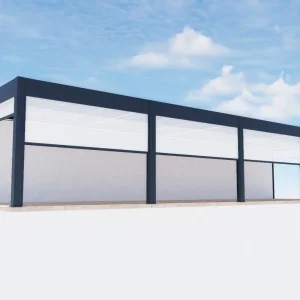
Multi-bay 8m×8m linked motorized pergolas deployed over beachside restaurant verandas. Integrated with high-tension micro-perforated zip screens that repel squall winds and tropical rain while locking out insects, maintaining 100% guest table turnover during sudden squalls.
Industrial Corporate Campuses
Heavy-duty louvered pavilions installed on corporate rooftop headquarters and employee plazas. Features acoustic sound-dampening insulated aluminum louver walls, dimmable 3000K perimeter LED lighting, and integrated Somfy automation interfacing with central BMS systems.
High-Density Urban Sky Lounges
Polanco and Zapopan penthouse installations utilizing motorized louver roofs coupled with structural frameless sliding glass doors. Provides full panoramic skyline views while satisfying tight municipal urban sound, setback, and fire safety ordinances.
Luxury Villas & Wineries
Freestanding architectural pergolas featuring woodgrain fluorocarbon sublimation finishes. Configured with exterior fixed privacy blade walls and bottom-tensioned solar drop screens to filter intense Pacific solar glare across open-air wine-tasting terraces.
Request Factory Direct B2B Pricing for Mexico Projects
Connect directly with our engineering division for structural CAD shop drawings, static wind load calculation reports, custom profile dies, and consolidated container quotes delivered direct to Mexican ports.
Engineered Architectural Assemblies: Walls, Doors & Shading
Expand your commercial inventory with high-margin, factory-warranted bioclimatic structural components engineered for North American and Mexican B2B importers.
B2B Procurement & Engineering FAQ for Mexico
Critical engineering, logistics, and compliance details for developers, facade consultants, and wholesale distributors importing to Mexico.
How do your pergola systems comply with Mexican seismic and wind codes?
Every structural project is supported by finite element analysis (FEA) calculations matching regional dynamic wind loads per Mexico's CFE (Comisión Federal de Electricidad) Manual de Obras Civiles. Structural baseplates utilize 12mm-16mm hot-dip galvanized or 316 stainless anchors with internal stiffeners that safely transfer lateral cyclic shear forces directly into reinforced concrete footings.
What is the ocean transit time and customs protocol for Mexican ports?
Direct maritime container shipping from Shenzhen or Nansha to Pacific ports (Manzanillo, Lázaro Cárdenas) typically takes 18 to 24 transit days; shipments to Veracruz via standard transit take approximately 30 to 35 days. We provide comprehensive export documentation including validated Commercial Invoices, Packing Lists with HS codes (7610.90 for architectural aluminum structures), Mill Test Certificates, and Certificates of Origin.
Can you provide custom RAL colors and woodgrain finishes for resort aesthetics?
Yes. In addition to our standard architectural matte palette (RAL 7016 Anthracite Grey, RAL 9016 Traffic White, and RAL 9005 Jet Black), we provide full custom powder formulation via AkzoNobel or Tiger Drylac color-matching systems. For eco-resorts in Tulum and Valle de Guadalupe, we offer 3D vacuum-sublimated architectural timber finishes that mimic Mexican cedar or teak while preserving the 100% fire-resistant, non-decaying structural advantages of 6063-T6 aluminum.
What electrical certifications apply to the integrated motors and controls?
All linear actuators, tubular motors, electronic control modules, and integrated LED power drivers are CE, UL, and RoHS certified, engineered to operate seamlessly on Mexico’s standard 110V/127V 60Hz single-phase electrical grid (or 220V commercial feeds). Smart motors feature 433MHz multi-channel wireless control, Somfy RTS protocol compatibility, and dry-contact relays for connection to central Crestron, Lutron, or Control4 hotel automation backbones.
How does the internal gutter system manage torrential tropical rainstorms?
Our perimeter ring beams feature deep-cavity integrated perimeter gutters capable of draining water volumes up to 150 liters per minute per square meter. Each louver blade is engineered with an overlapping co-extruded EPDM sealing fin that directs water down the blade slope into perimeter collection channels, passing down concealed vertical PVC pipes housed within the hollow structural posts to prevent exterior wall splashing.
What is the minimum order quantity (MOQ) and private label OEM policy?
For standard project specifications, our baseline order quantity begins at a single custom project module. For regional distributors and aluminum window and door manufacturers in Mexico seeking white-label distribution partnerships, we offer dedicated private-label packaging, branded instruction manuals, showroom display discounts, and mixed-container consolidation allowing pergolas, zip shades, and sliding glass wall systems to ship together.