
Choosing the right Pergola For Hotels from China starts with how guests will use the space. Will it shade a pool terrace, cover an outdoor dining area, or protect a quiet lounge beside the lobby? Each setting places different demands on the structure. Measure the site carefully, including clearances, drainage paths, and access for installation. A sleek aluminum frame may suit a coastal resort, while a warmer finish may fit a garden restaurant. Looks matter. So do maintenance and repair access.
For transparency, the quotation below is an editorial line from a fictional composite expert, not a verified statement by a real person: “A pergola succeeds when it makes the outdoor space comfortable on an ordinary busy day.” This guide examines frame materials, adjustable louvers, fabric options, coatings, and practical questions to ask Chinese suppliers. Request drawings, finish samples, component specifications, and details about production checks. Confirm how the proposed design handles local weather conditions with a qualified project professional. Compare warranties and lead times in writing, and clarify who coordinates shipping, installation, and after-sales support. A showroom sample can look convincing under soft lights; a real site may expose glare, noise, or awkward drainage. Some details are easy to miss. Price alone will not reveal them.
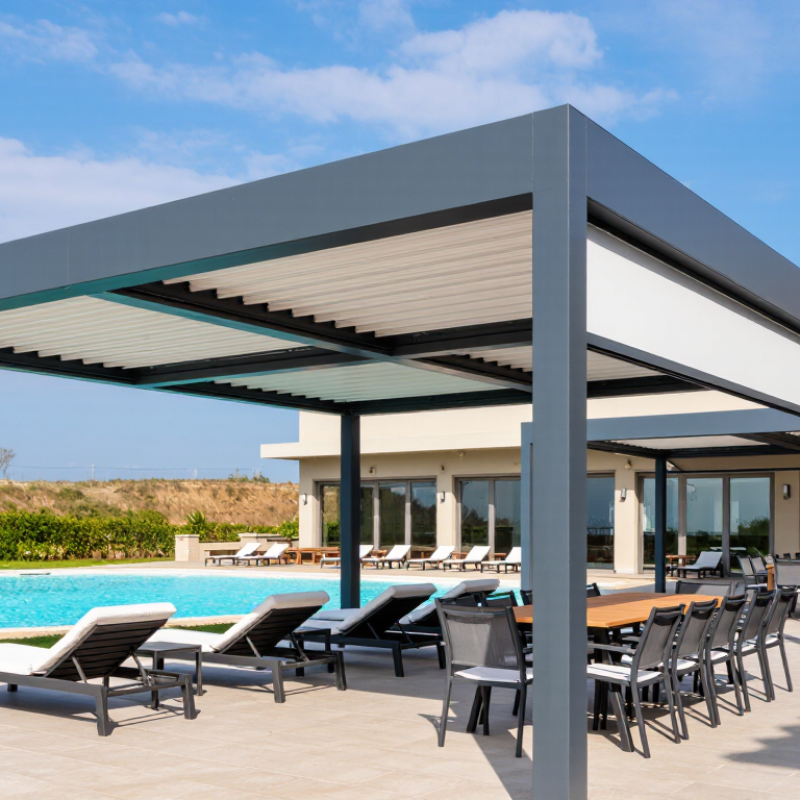
Start with the guests and the hours they use the space. A poolside pergola may need broad shade at midday, while a restaurant terrace needs clear circulation and rain protection. STR reported 63.4% average U.S. hotel occupancy in 2024, a useful market benchmark—not a forecast for your property. Estimate peak seating, staff routes, and maintenance access from your own operating records. Shade matters.
Climate should shape the specification. The U.S. Environmental Protection Agency reports that urban areas can be 1–7°F warmer by day than nearby rural areas. That makes shade and airflow important for many city hotels, but a solid roof can trap heat if poorly planned. Consider adjustable louvers, drainage, and how screens may affect ventilation. Small details count.
Before requesting a China-made pergola, document the site dimensions, intended use, exposure to wind or snow, and preferred finish. Ask for drawings, material specifications, and installation requirements; have a qualified local professional review the structure and site conditions. Do not choose by price alone. I would reconsider any plan that ignores cleaning access or replacement parts—those needs are easy to overlook during a showroom review. A beautiful structure can still frustrate staff.
A hotel pergola should be chosen around its actual job: shade for dining, shelter beside a pool, or a defined outdoor event space. Start with the site. Note afternoon sun, prevailing wind, salt exposure, and where rainwater will drain. Small details matter. A post placed across a service route can turn an attractive design into a daily obstruction.
Compare structure and upkeep, not just appearance. Aluminum is light and generally needs less routine care; steel can support larger spans but needs suitable corrosion protection. Timber feels warm, though coatings and inspections add work. The U.S. Energy Information Administration’s 2018 Commercial Buildings Energy Consumption Survey reports average site energy use intensity of about 70.6 thousand Btu per square foot for lodging buildings. That figure does not predict pergola savings, but it makes shade and outdoor comfort worth evaluating as part of a wider building strategy.
For a China-sourced system, request project-specific structural calculations, finish details, drainage drawings, and replacement-part information. Match the roof to the task: adjustable louvers offer flexible shade, while fabric canopies provide softer filtered light but require fabric-care planning. Check wind exposure and hardware access before approving the layout. One easy-to-miss weakness is a beautiful sample finish that has not been assessed for the hotel’s coastal or humid conditions. Ask for relevant test documentation, then review a full-size sample outdoors; color and glare can look different in real sunlight.
When sourcing a hotel pergola from China, assess the factory’s engineering process, not just its catalogue. WTTC’s 2024 Economic Impact Research estimated travel and tourism generated 9.1% of global GDP in 2023. That scale makes durable outdoor guest spaces a practical investment, but the figure is not proof of demand for any specific pergola. Ask for drawings, alloy grades, coating specifications, and load calculations for your site’s wind and snow conditions. Request inspection records from production, not only polished showroom photos. Small details matter: water should drain away from beams, and fasteners should suit the local exposure. Ask how replacement parts are identified. It saves trouble later.
Check standards carefully. ISO 9001 certification describes a quality-management system; it does not certify a pergola’s structural performance. For aluminum components, ask whether relevant design and fabrication requirements, such as EN 1090 where applicable, are documented and independently verified. Request test reports that identify the exact model, dimensions, materials, and test conditions. A salt-spray result without those details is weak evidence. Confirm the report comes from a competent testing laboratory, and compare its scope with your project specifications. Then review warranties, installation instructions, and packaging plans with the same care. Shipping damage is not theoretical. And paperwork can still miss a flaw. A sample assembly or third-party pre-shipment inspection can reveal fit problems before a large hotel order leaves the factory.
| Assessment dimension | What to verify with the manufacturer | Relevant standard or evidence | Hotel-specific decision check |
|---|---|---|---|
| Product configuration | Confirm whether the system is fixed-roof, retractable-fabric, or adjustable-louver, and identify which components are included in the quotation. | Request dimensioned drawings, operating descriptions, bill of materials, and a written scope covering frame, roof, drainage, controls, and installation. | Match the configuration to the intended use: guest dining, poolside shade, or a weather-protected terrace. Do not assume that “pergola” describes one standardized product. |
| Structural design and wind | Ask for design calculations for the proposed span, height, fixing method, and site exposure. Check whether the quoted wind performance applies to the complete system or only selected components. | Request project-specific structural calculations and any applicable test reports. For external blinds or awning elements, EN 13561 addresses performance requirements including wind resistance within its scope. | Set the design wind criteria with the project’s structural engineer and local code requirements. A product test result is not automatically a site-specific structural approval. |
| Aluminium frame and finish | Check alloy and temper designations, profile dimensions, wall thicknesses, coating type, and preparation process. Request coating and corrosion-test documentation for the specified finish. | GB/T 5237 is a series covering aluminium alloy building profiles; its relevant part depends on the surface treatment, such as anodizing or powder coating. Verify the exact part and edition cited in the documents. | For coastal or humid sites, specify the required finish and exposure conditions in the purchase documents. Ask whether the offered test sample and report match the ordered profile and coating system. |
| Roof, fabric, and water management | For fabric roofs, verify fabric composition, coating, UV and water-performance claims, and replacement method. For louvers, review blade seals, guttering, outlets, and overflow paths. | Request manufacturer data sheets and test reports for the exact fabric or roof assembly. Ask for drainage details and, where available, a documented water-spray or rain test procedure. | Confirm how the system performs in wind-driven rain and where water discharges. Avoid treating a water-resistance claim for fabric alone as proof that the assembled pergola is watertight. |
| Electrical components and controls | List motor, power supply, sensors, switches, and control method. Check the rated voltage, wiring diagrams, available manual operation, and replacement-part availability. | For electrical enclosures, IEC 60529 defines IP-code ingress-protection classifications. IEC 60335-2-97 covers safety requirements for drives for rolling shutters, awnings, blinds, and similar equipment; applicability depends on the drive and product arrangement. | Have the project electrician verify local electrical-code compliance, installation conditions, and protection requirements. Request certificates and test reports for the actual electrical components supplied. |
| Structural component conformity | Ask whether any steel or aluminium parts are being supplied as structural components and what design, fabrication, and traceability controls apply. | EN 1090-1 concerns conformity assessment of structural steel and aluminium components where it applies. Request the relevant declaration and factory production-control evidence when required for the project or market. | Confirm applicability with the project designer and destination-market requirements; do not treat EN 1090-1 as a general certificate for every pergola or every component. |
| Quality management and production control | Review the manufacturing process, incoming-material checks, in-process inspections, final inspection records, and procedures for nonconforming products. | ISO 9001 certification is evidence of a quality-management system within its stated scope, not proof that a particular pergola design meets structural or performance requirements. Verify the certificate scope and validity. | Request inspection records tied to the project order, approved drawings, and product serial or batch identification rather than relying on a certificate alone. |
| Prototype and pre-shipment inspection | Agree on a sample or first-article review, measurable tolerances, appearance criteria, packaging checks, and a written inspection plan before production. | Use approved drawings, purchase specifications, and documented inspection results as acceptance evidence. Any third-party inspection should have a defined scope and sampling plan. | Check dimensions, finish consistency, moving parts, drainage details, accessories, and packing against the approved submittal before shipment. |
| Installation and after-sales support | Confirm installation instructions, anchoring details, required site tolerances, commissioning steps, warranty terms, and availability of replacement components. | Request a parts list, maintenance schedule, warranty document, and written process for technical support and spare-parts orders. | Clarify who is responsible for foundations, electrical connections, lifting equipment, installation, and local approvals. Check that maintenance requirements suit hotel operations. |
| Commercial and delivery risk | Compare lead time, production milestones, packaging method, shipping terms, payment schedule, and remedies for deviations from approved specifications. | Use a signed specification schedule, approved drawings, inspection milestones, and clear Incoterms® rules in the order documents. | Allow time for design review, sample approval, production inspection, freight, customs clearance, and on-site installation before the hotel’s opening date. |
Note: Standards and certifications should be checked against the destination market, project design, product scope, and current applicable editions. The checks above are a procurement framework, not a substitute for project-specific engineering or regulatory review.
For a hotel, climate suitability starts with the site, not the catalogue. Record prevailing wind, seasonal rain, sun direction, salt exposure, and winter conditions before comparing pergola options. Coastal air can corrode ordinary fittings, while strong afternoon sun may leave an open seating area uncomfortable. Salt air changes everything. Request material grades, coating details, drainage plans, and wind-load documents from the China-based supplier. A qualified local professional should check the design against actual site conditions.
Installation deserves equal attention. Confirm finished dimensions, foundation requirements, drainage routes, and service access before shipment. A pergola placed over paving may still need deeper footings beneath it. Wind matters, too. Align posts carefully, keep water away from doorways, and protect electrical connections if lighting or motorized louvers are included. Give the installation crew clear drawings and a written sequence. Small measurement gaps can become expensive once materials arrive. That is easy to underestimate.
Maintenance affects appearance and guest comfort. Set a routine to rinse dust and salt from frames, clear leaves from gutters, and inspect bolts, seals, and moving parts. Check fabric or louver mechanisms after storms, not only during annual servicing. Keep spare fasteners and care instructions on site. There is no universal schedule; local weather and guest use change the workload. A practical choice may look less elegant on paper, but staff can inspect it more easily between busy shifts.
Approximate long-term annual precipitation provides a useful first screening factor: wetter locations call for careful drainage design, weather-resistant finishes, and a maintenance plan for seals and fixings. These city-level figures are not site-specific design values. Before ordering, confirm local wind and snow loads, coastal corrosion exposure, installation requirements, and applicable building codes with a qualified local professional.
Annual precipitation values are rounded climate averages; actual conditions vary by location and year.
For a hotel, pergola cost goes beyond the factory quote. Compare materials, roof type, finish, drainage, packing, freight, and installation support as separate line items. Request drawings, load assumptions, and a written finish specification before comparing offers. Small omissions matter. A low price can look attractive until replacement parts or site adjustments appear.
Customization should solve an operating need, not just match a mood board. Measure the terrace at several points, note sun and wind exposure, and map guest circulation, service routes, and door swings. Share photos and dimensions with the supplier, then approve a scaled drawing and finish sample. Leave practical clearance for furniture and maintenance. Not every requested detail earns its cost.
For long-term value, weigh cleaning time, corrosion exposure, UV stability, spare-part availability, and warranty exclusions alongside purchase price. Ask how moving parts are tested and what routine care is expected; request documentation rather than relying on verbal assurances. Compare landed cost and expected upkeep over several years. There is uncertainty. Freight delays, labor costs, or imperfect measurements can change the budget, so keep contingency and verify site conditions before production.
Start with guest use, peak seating, and staff routes. A poolside area may need broad midday shade, while a restaurant terrace needs clear circulation.
Measure the space and note sun, wind, rainwater drainage, and nearby doors. Check service paths too. A post can obstruct a busy route.
Heat, coastal air, wind, and snow can influence roof, finish, and structure choices. Louvers may allow airflow, but poor planning can still trap heat.
Aluminum generally needs less routine care. Steel can support larger spans but needs corrosion protection. Timber feels warm. It may require more inspections and coating work.
Adjustable louvers provide flexible shade. Fabric canopies create softer filtered light, but need a fabric-care plan. Check wind exposure and hardware access.
Request project-specific drawings, structural calculations, finish details, drainage plans, installation requirements, and replacement-part information. Have a qualified local professional review the plans.
Compare packing, freight, installation support, site adjustments, upkeep, and spare parts. A low quote may not show the whole cost. Keep a contingency.
Consider cleaning time, corrosion exposure, UV stability, warranty exclusions, and routine care. Ask how moving parts are tested. I might still overlook a small maintenance detail.
Choosing the right Pergola For Hotels starts with understanding how guests and staff will use the space, whether for dining, relaxation, events, or shade around a pool. Compare designs, materials, and features such as adjustable roofs, drainage, lighting, and wind resistance, then assess manufacturers in China for consistent workmanship, clear product specifications, and relevant quality documentation.
Before making a decision, consider local weather, site conditions, installation requirements, and the maintenance needed to keep the structure in good condition. Request details about customization, delivery, installation support, warranties, and total ownership costs—not just the initial price. A well-chosen pergola should complement the hotel’s architecture, suit its climate and daily operations, and provide dependable value over time.
